Homo
The Man Who LaughsHomo is the wolf who shares Ursus’s wandering life, work, and home, and whose quiet actions repeatedly matter to the people around them. He draws and guards the traveling van, performs with Ursus’s company, helps Ursus find an abandoned infant, and later guides Gwynplaine toward a ship and safety. The bond between man and animal is presented as a reciprocal companionship, not simply a useful arrangement: Homo is at once worker, performer, family member, and independent actor within the story.
Identity and Partnership
Homo is a real wolf, not a dog or a wolf-like animal, although his habits and sounds invite comparisons with both. He is five feet long, strong, lean from a life in the forest, and accustomed to long distances: before joining Ursus, he could travel fifty miles in a night. He eats medlars and potatoes, has a soft tongue with which he sometimes licks Ursus, and gives a howl that can lengthen into a bark. These details distinguish him as an animal with particular habits and abilities, rather than as a generic stage wolf.
Ursus gave the wolf his name and appears to have chosen his own to match it. The pairing makes their companionship legible as a playful correspondence: Ursus considers Homo a counterpart, not merely an animal under his care. He tells the wolf that he has found a second volume of himself and imagines that anyone seeking to know him after his death could study Homo as a faithful copy. The comparison does not erase the difference between them. Rather, their friendship rests on a perceived likeness of disposition across the human-animal boundary.
The partnership has also lasted long enough for both companions to grow old together. They travel from one market to another, across towns and shires, without leaving Great Britain. In bad weather or on difficult roads, Homo draws the van; when the ground is too muddy, steep, or rutted, Ursus attaches himself to the harness and pulls beside him. The arrangement makes their labor visibly shared. Homo is trained to serve a practical purpose, but the description of Ursus pulling alongside him stresses fellowship rather than command alone.
The Traveling Home and Performance
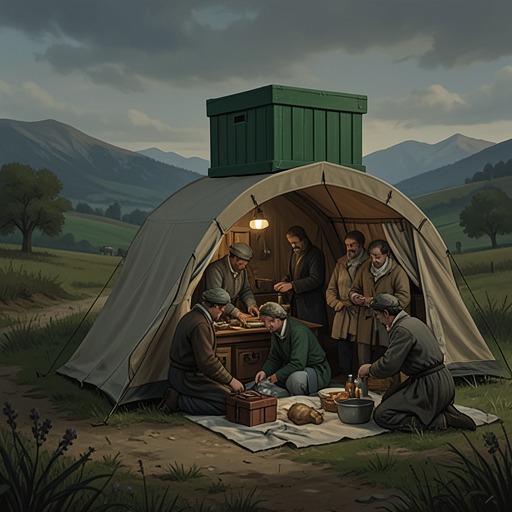
The van is both vehicle and dwelling, and Homo belongs to the domestic life it contains. He draws it by day and guards it at night. The household moves between commons, woods, village outskirts, market-places, and other makeshift stopping places; the van’s steps and doors allow the travelers to turn a road-side halt into a secured home. Homo’s place in this life is so established that the arrival of the children makes Ursus joke that he will be their father and Homo their uncle.
As the company grows into a more successful theatrical establishment, Homo’s role changes with it. The old van is enlarged into a theatre, while Homo is described as chained beneath it when not performing. Onstage he is a utility performer, appearing in small parts as circumstances require. In performance, he and Ursus can stand side by side in their animal costumes, each embodying an animal identity for the audience. The wolf is thus both the company’s actual animal and part of its theatrical craft.
Ursus publicly presents Homo as educated, grave, sagacious, humble, helpful, and charitable. His speech turns the wolf’s habits into a comic argument about civilization: Homo howls in sympathy with human beings and barks as a concession to them. The performance makes the audience laugh, but it also unsettles easy distinctions between animal nature and human conduct. Ursus praises Homo’s lack of aristocratic prejudice and his unadvertised helpfulness, using the wolf as a contrast to social vanity. These are Ursus’s public descriptions, yet Homo’s conduct elsewhere gives them substance: his care is shown in action, without a speech or demand for recognition.
Care, Caution, and the Family
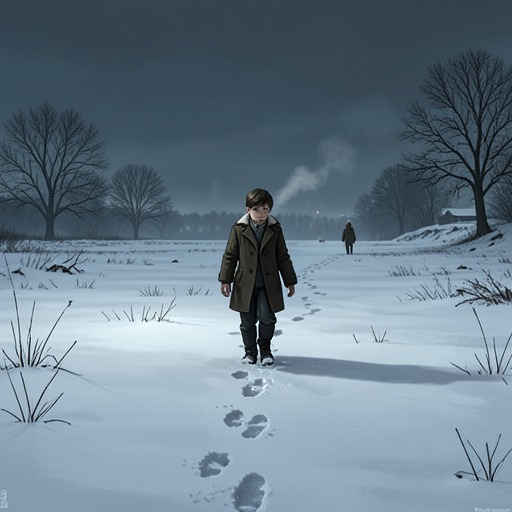
Homo’s first decisive act of care comes when Ursus searches through snow for the infant he has found. Ursus says he would still be digging through the snow without Homo, whose sense of smell helps locate the child. Once they return to the van, Homo approaches the sleeping infant and softly licks the child’s dangling hand without waking her. Ursus responds by assigning him the place of uncle in the new family. The scene makes Homo’s gentleness concrete: he is not merely present while Ursus takes in the child but participates in the household’s welcome.
Homo’s attention is not limited to the children’s infancy. He remains with Ursus as the traveling group grows older, and he continues to share its work and performances. When Ursus speaks to an audience about the company, he describes Homo as helpful and charitable while the wolf himself remains a quiet presence. At other moments, Homo’s silence is watchful rather than passive. He sits up and looks toward a door, baring his teeth; elsewhere, he is described as prudent when the circumstances call for caution. The narration suggests that he can register danger, though it does not claim certainty about the extent of his understanding.
That caution takes on a social dimension when Ursus and his troupe face an order to leave England. The official threat includes Homo specifically: if he remains, he will be seized and killed. Ursus reports the order to him, and the danger reveals how precarious the wolf’s place is under human authority. The animal who has drawn the performers’ home, entertained audiences, and cared for a child can be treated by officials as an object to be registered and removed. Homo’s dependence on the troupe therefore coexists with a vulnerability that the other members do not share in the same form.
Guide and Final Presence
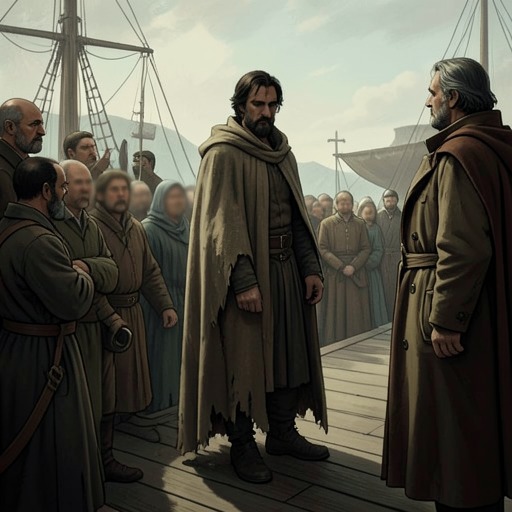
Near the end of the story, Homo becomes essential to Gwynplaine’s movement from danger toward refuge. After a period of upheaval, Gwynplaine encounters him and experiences his appearance as an unexpected return of hope. Homo leads him down the slope of the quay at Effroc stone toward the Thames and the vessel waiting there. Gwynplaine follows the route the wolf takes. Later, aboard the ship, Homo softly strikes his tail against the deck planks, a small gesture that places him among the survivors of the separation and flight.
Homo’s importance in this passage depends on what he does, not on an explanation of what he knows. He finds the path and leads; the narration does not turn him into a speaking guide or assign him a human plan. The contrast is central to his role throughout the book: Homo can be a working animal and a performer within human arrangements, but his practical intelligence and attachment also alter what happens. His nose helps find the infant; his watchfulness anticipates danger; his route gives Gwynplaine a way toward the ship.
The final image of Homo comes after Ursus regains consciousness and discovers that Gwynplaine is gone. Homo stands at the edge of the deck baying in the shadow and looking down toward the water. This is his last recorded action, and its circumstances connect the wolf to the story’s final loss without claiming that he understands it as a human would. Across the narrative, Homo’s presence has joined labor to affection and caution to care. He is not simply Ursus’s emblem or a device for rescuing others: he is the enduring animal companion whose ordinary acts of guarding, licking, watching, performing, and leading become consequential at moments when the human characters are most exposed.